
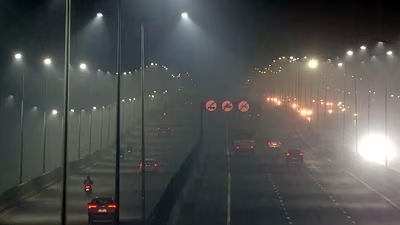
Delhi’s air quality was in the ‘very poor’ category on Sunday, but set to worsen after Diwali celebrations in the evening.
The average Air Quality Index (AQI) for the day settled at 376 in the ‘very poor’ category as a thick layer of smog enveloped the city and reduced visibility.
Several monitoring stations have already breached this mark, indicating deterioration in air quality across the capital. Weather and air quality experts have attributed the anticipated deterioration to unfavourable meteorological conditions, the onset of Diwali-related celebrations and vehicular emissions, along with the peak period of stubble burning in neighbouring states. Unfavourable meteorological conditions are further aggravating the situation.
Of the 59 monitoring stations that recorded data on Sunday, air quality was in the ‘severe’ category at 12 and in the ‘very poor’ category at 22. The worst AQI was recorded in Jahangirpuri at 463. The city’s average AQI increased from 369 on Saturday to 376 on Sunday, remaining not far from the ‘severe’ threshold of 400. The air quality is likely to remain in the ‘severe’ category from November 9 for a few days, according to the Air Quality Early Warning System (EWS) for Delhi . As per the Central Pollution Control Board (CPCB), an AQI between 0 and 50 is classified as ‘good’, 51 and 100 as ‘satisfactory’, 101 and 200 as ‘moderate’, 201 and 300 as ‘poor’, 301 and 400 as ‘very poor’, and 401 and 500 as ‘severe’. A ventilation index below 6,000 square metres per second, coupled with an average wind speed of less than 10 kilometres per hour, is unfavourable for the effective dispersion of pollutants, according to the EWS. PM2.5 was the predominant pollutant in the national capital on Sunday, with emissions from firecrackers adding to the levels of particulate matter. The transport sector is set to be the largest contributor to the city’s pollution on Sunday, accounting for 19 per cent, according to the Decision Support System (DSS) for Delhi. Stubble burning is set to contribute 3.5 per cent, with forecasts suggesting that the contribution might remain around 2.99 per cent on Monday.
The air quality is forecast to turn ‘severe’ on Monday following Diwali celebrations, combined with vehicular emissions, as well as the peak stubble-burning season.
