
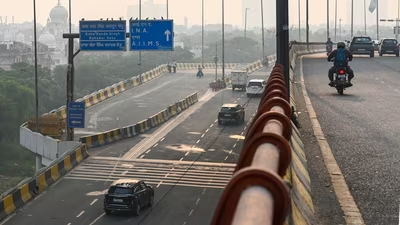
In an attempt to resolve chronic congestion on the Barapullah elevated corridor, Delhi Traffic Police has installed cat’s-eye reflectors and introduced a smoother curvature at a key merging point, where traffic from multiple stretches converges, officials said.
The intervention comes after the newly opened corridor triggered widespread congestion, with traffic from Mayur Vihar , Sarai Kale Khan, Ring Road and the Ashram-DND side—totalling nine lanes in all—funnelled into a stretch that has only three lanes. Cat’s eye reflectors , to be sure, reflect light from vehicle headlights back towards drivers, helping them identify lane boundaries and follow the road’s curvature. Combined with the smoother transition, the markers are expected to provide better guidance to motorists approaching the convergence point and reduce abrupt manoeuvres.
“The measure is aimed at improving driver visibility and guidance, and ensuring smoother convergence of vehicles at the junction where Phase-3 meets the existing Barapullah flyover ,” a senior traffic police officer said.
HT has reported on the physics behind the congestion, detailing how forced mergers and sudden braking can trigger backward-moving waves of traffic, especially when vehicles travelling at different speeds are forced to change lanes in a short distance.
The officer said, “The cat’s-eye reflectors, embedded along the road surface, are intended to make the alignment of the road and the merging path more visible to motorists, particularly in low-light conditions.
