
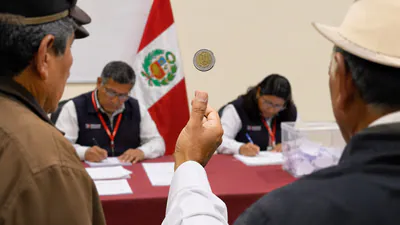
A mayoral election in Peru was decided by the toss of a coin after two candidates received exactly the same number of votes, leaving electoral authorities to rely on an unusual but legally recognised method to determine the winner.
(Also read: Peru airport security finds 3,000 tarantulas hidden in dirty socks inside three suitcases )
An electoral official tossed a one-sol coin into the air, with the result favouring Quispe, who had selected the reverse side. Speaking after his victory, Quispe expressed gratitude for the unexpected outcome. The procedure was not an improvised solution but a mechanism explicitly permitted under Peruvian electoral legislation. Despite acknowledging that the method was lawful, Mamani expressed dissatisfaction with the outcome. Watch magnificent nature ) The incident was not unprecedented.
The unusual contest took place in Conima, a small district in Peru’s Andean highlands near Lake Titicaca, according to an AFP report published on November 6. The coin toss ultimately favoured Rubén Quispe Capajaña of the Somos Perú party, who defeated his rival Salomino Mamani Quispe of País Para Todos despite both candidates securing 671 votes each. The candidates had contested the municipal elections held on October 4. Official results from Peru’s National Office of Electoral Processes (ONPE) showed that both secured 27.739 per cent of the valid votes, creating an exact tie. With neither candidate emerging ahead, the Special Electoral Jury (JEE) of Huancané organised a public draw on November 4 to determine the winner. Under Article 26, Clause 6 of Peru’s Municipal Elections Law (Law No. 26864), a tie between candidates receiving an equal number of votes must be resolved through a draw. For the 2026 municipal elections, however, Peru’s National Elections Jury issued a Plenary Agreement dated October 28, standardising the procedure and requiring electoral juries to use a one-sol coin to ensure clarity and fairness. Conima, situated approximately 3,860 metres above sea level, has around 3,500 residents. (Also read: Old video of the Red River in Peru goes viral. Peru’s electoral authorities have previously used similar procedures, including in municipal elections in 2010, 2014 and 2022.
“I always wanted to win, and God decided it,” he told reporters, according to AFP. He called for electoral reforms allowing a second round of voting in tied contests rather than determining the winner by chance, according to Peruvian news agency Andina .
Such draws have previously involved tossing coins or drawing balls bearing political parties’ symbols.
