
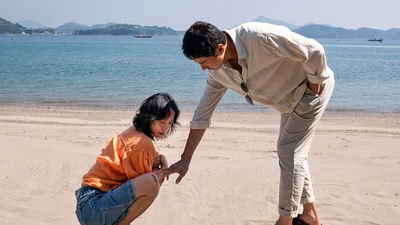
South Korean writer and director is back after eight years with a new film, after 2018’s mysterious and haunting Burning. There are films which are easy to describe and even easier to write about. Lee Chang-dong’s Possible Love is not one of those films. Almost novelistic in its depth and brimming with rich details, this is a film that takes some time to settle in, but once it does, it casts a hypnotic spell. There’s an almost transcendental quality in the way this film examines life in all its contradictions, one that cannot be explained.
Perhaps due to their unidimensional nature and the way it all comes together for the viewer.
Long scenes play out in a slippery matrix of desire and friction, expertly shot by Kim Ji-yong and edited by Kim Da-won. In broad strokes, it is a film about two married couples getting to know each other. They are from starkly different economic backgrounds and become acquainted while filming a documentary in the aftermath of a massive corporate labour layoff. On one side are the laid-off worker and his spouse, who open their lives and rooms (and hearts) to a documentary filmmaker and her spouse. Beneath this, it is also a film about the very act of filmmaking, the ethics of documenting, and the unspeakable friction of class and desire. Possible Love, which the director co-wrote with Oh Jung-mi, is a film about that indecipherable sting of power and the lack of it. It is a film about the shadow lines of class and privilege that shape how people live and communicate. One does not talk about these little elements, but they are always noticing, thinking, and calculating. Even though Mi-ok and Ye-ji promise to become friends, they are two different people with different ways of life. The way Mi-ok dresses and holds the big wine glass on the table stands out in contrast to the rest, and she is the one who notices the expensive bag Ye-ji carries. With so many underlying character threads and wordless sexual charge rapidly pushing forward, it is astonishing how tightly Lee maintains a grasp over the narrative. The film’s silent character in question is Ho-seok, who refuses to seek group therapy and would not come in front of the camera for an interview. But when Lee tightens the grip and the wall breaks, it is a moment of hair-raising anguish. It is the film’s most arresting image. Kyung-gu, who has frequently worked with Lee, is magnificent. Cho Yeo-jeong and Zo In-sung are very effective, too, managing to create that flippant ease of privilege.
