
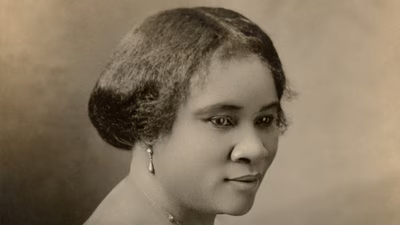
Sarah Breedlove spent many years washing clothes to make ends meet for herself and her daughter. Under the name Madam C.J. Walker, she built her hair-care products business with clients across the country.
She turned her fight against hair loss into a business in Indianapolis, according to the National Park Service .
The National Museum of African American History and Culture notes that Breedlove enrolled at Annie Turnbo Malone’s Poro College in St. Louis and later became an agent for the Poro Company. She sold Malone’s hair and scalp products before developing her own line, drawing on her personal experiences with hair loss and the training she received at the college. She reinvested the profits in ingredients and newspaper advertising. Her husband assisted her with promotion and mail orders, but there was a lot of disagreement between them about the business, and they later separated. Walker appointed her daughter as a mail-order agent while she traveled for promotion of the products. She recruited hairdressers and sales representatives. The National Park Service (NPS) reports that Walker’s agents were trained to develop home beauty businesses, maintain records, and serve their customers. She established a factory, a salon, and a training school in the city. Ransom and factory forewoman Alice Kelly.
In 1908, Walker moved to Pittsburgh to start a school for the Walker System of Hair Culture called Lelia College. Her business eventually expanded to 5,000 agents across the country and generated $7,000 in weekly revenue. In 1913, Walker opened a base in Harlem, New York, which included living quarters, a salon, and a school for salon operators. Walker permanently moved to Harlem in 1916, while the Indianapolis operations continued under attorney and general manager F.B.
Because its railway facilities made it easier to ship mail orders, walker selected Indianapolis as the base of her operations in February 1910.
