
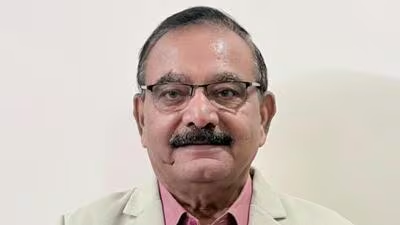
When wing commander Radhey Shyam Pandey bought a plot of land in New Palam Vihar in 1999, he saw it primarily as an investment. Gurugram, with its open spaces and fields, seemed a promising place to own property. He had also heard that several veterans from his community were choosing to settle in the city after retirement.
What he had not anticipated was how deeply he would eventually become involved in the everyday concerns of the city and its residents. As Gurugram has expanded around him, he has become involved in efforts to improve neighbourhood infrastructure, address civic problems and help fellow veterans access essential services. For Pandey, the involvement began close to home. Rather than wait for the problem to be resolved, Pandey began mobilising residents to contribute towards improving access. But the project was not simply about making the neighbourhood more accessible. Ficus trees were planted along the stretch, with nameplates bearing the names of children, an effort to encourage them to take an interest in environmental conservation and develop a sense of responsibility towards their surroundings. Multicoloured flags were also installed along both sides of the road. The flags eventually gave the stretch a name of its own. Growing up in Sultanpur, Uttar Pradesh, Pandey attended schools where electricity was unavailable and even adequate lighting could not be taken for granted. Those memories stayed with him long after he left school and joined the armed forces. Years later, they prompted him to file a public interest litigation in the Punjab and Haryana High Court, seeking uninterrupted electricity supply to government schools across Haryana. “For me, this was a matter of personal importance. His involvement has also extended to healthcare, particularly for people who have served in the armed forces. Helping fellow veterans has since become another important part of his life in the city. He has spent considerable time developing a support network for former servicemen living in Gurugram and elsewhere in the National Capital Region. The work ranges from taking up infrastructure-related concerns with the Municipal Corporation of Gurugram and the Gurugram Metropolitan Development Authority to helping veterans find appropriate healthcare facilities. These include free ambulance services, home healthcare, air and train ambulance services, physiotherapy centres and non-governmental organisations working in cancer care. Across these initiatives runs a common approach: identifying a problem, bringing people together and finding ways to address it. Having watched Gurugram transform over nearly three decades, he appreciates the scale of its development. But he also believes the city’s progress has been uneven. “I have seen big buildings come up, expressways being built and intercity connectivity improve. Yet he does not believe the responsibility for improving the city rests with the administration alone. Residents, he feels, must also take an active interest in their neighbourhoods, organise themselves and work with civic agencies to find solutions. And just like that, the city that once represented a promising investment has become something considerably more personal: a place whose future concerns him.
In 2016, two years after retiring from the Indian Air Force, Pandey moved to Gurugram with his family. After 38 years of service that had taken him across the country, he was looking for a place where they could finally put down roots. A decade later, the 70-year-old has found himself doing considerably more than enjoying retirement. Together, they raised ₹ 7 lakh and got a 1.5km stretch of road built. During the devastating second wave of the Covid-19 pandemic, Pandey worked with the Park Group of Hospitals in Gurugram in efforts to maintain oxygen supplies to five hospitals run by the group. He has brought together a network of around 57 hospitals empanelled under the Ex-Servicemen Contributory Health Scheme (ECHS), along with 29 non-empanelled medical facilities and service providers.
“When I first moved here, there were hardly any internal roads connecting our neighbourhood to the arterial road,” he recalled. “Now it is called the jhande wali gali,” Pandey said, laughing. Without a continuous power supply, how will a child learn to use a computer?” he said. But it pains me that problems as basic as water drainage and broken roads continue to plague the city,” he said.
