
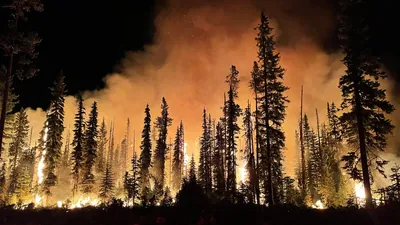
Afforestation was associated with a 26% higher probability of fire occurrence and a 23% larger burned area, according to a study published in the Proceedings of the National Academy of Sciences (PNAS). Afforestation can increase forest cover supply and aid in addressing the issue of Climate Change. However, transforming open land to afforested land can alter the behavior of wildfires.
Through satellite data analysis, the researchers looked at changes in fire incidence before and after these transformations, taking into consideration climate , accessibility, and land area. The findings varied considerably across biomes, suggesting that the effects of tree planting depend on the location and type of landscape. The biggest difference was seen in temperate conifer forests. The researchers speculate that high vegetation density and harsher fire weather might be causing this phenomenon. Continuous vegetation acts as a fuel source for fires. There were also increases in fire activity in Mediterranean forests, woodlands, and scrublands. These landscapes experience periodic drought , contain flammable vegetation, and are frequently affected by human-caused fires. The researchers suggest that increased biomass from planted forests may add to the available fuel, potentially contributing to greater fire activity. On the other hand, temperate broadleaf and mixed forests showed a reverse pattern. This suggests that although fires occurred less frequently, the overall area affected by fire increased. Since nearly half of the world’s planted forests are located within this biome, even modest changes in fire behavior could have substantial ecological and socioeconomic consequences. The only biome that did not show an increase in wildfire activity was temperate grasslands, savannas, and shrublands. The institution’s press release states that plantations can serve as sources of timber, biomass, and other ecosystem services such as soil stabilization, but their location requires careful evaluation.
The study analyzed 67,248 land areas that were transformed from non-forest land to planted forests between 2001 and 2023. After afforestation, there was a 2.7-fold increase in fire incidence, and the amount of land burned doubled. The study found that afforestation was associated with a 38% rise in fire occurrence and a 9% increase in expected burned area in this biome. Afforestation in these landscapes was associated with a 23% decline in fire occurrence but a 20% increase in expected burned area, indicating that fires became less frequent but larger. Here, afforestation was associated with an 18% reduction in fire occurrence, without a significant increase in burned area.
This is likely due to the natural fires experienced in such landscapes, as well as the long-term human experience in using fire.
The University of Eastern Finland , one of the institutions involved in the study, said the findings show that fire risk should be considered when establishing new forests. The research team sought to investigate whether the effects of fuel condition modification vary depending on the landscape, according to lead author Irene Repeto-Deudero.
