
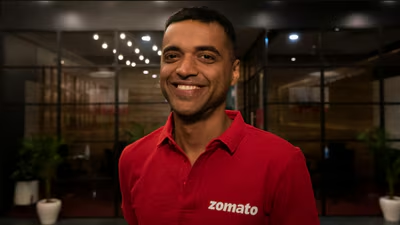
Eternal founder Deepinder Goya l has defended his ₹ 85,000 brain-monitoring wearable, Temple, insisting that the company is confident about the science behind the device and is not making unsubstantiated claims to generate profits. His remarks came after the device was criticised over its scientific claims.
Among those questioning the wearable was hepatologist Dr Cyriac Abby Philips, popularly known as The Liver Doc, who called the device “the biggest health scam and wellness fraud in India”.
Addressing questions about the scientific evidence supporting the wearable, Goyal said several wearable technology companies had launched products before publishing validation studies. If the product doesn’t work, it fails out of the gate and the company dies before recovering a tenth of its R&D,” he wrote. “I left the Eternal CEO role to chase purpose with Temple. This is not about money. “At some point you have to stick your neck out and say: we believe in our science, and the product is now valuable enough for people to pay for and use. We believe we are there. More validation continues in public,” he added.
“We have 14-day, no-questions-asked returns (which even Apple doesn’t offer in India). I have enough of it to last for generations,” he said, adding that he was not willing to risk a reputation built over 20 years for a quick profit. Citing Whoop as an example, he said the company had shipped its fitness band in 2015, with its first published validation following a few years later.
Because customers were being offered a 14-day, no-questions-asked return policy, he argued that the product could not be a scam.
In a statement addressed to “concerned Indian doctors” on X, Goyal said the company had already spent $30 million developing Temple, of which $20 million came from his personal funds. Goyal also said that his decision to step down as CEO of Eternal, the parent company of Zomato and Blinkit, was driven by his interest in pursuing Temple rather than financial gains. This demonstrated that people associated with the company and its product had confidence in its work, according to Goyal. “We hold ourselves to a higher standard; pre-prints are a step prior to peer reviewed publications, and they are coming up,” he wrote.
He further claimed that employees had invested in an earlier funding round, while the latest fundraising effort was largely backed by customers.
Goyal maintained that the company stood by its research methods and that its claims could be independently verified by individuals and institutions. He also expressed confidence that independent studies would emerge once the device became available to users. “We are confident that we are building something that the world is going to be positively astonished with. We stand by our science and our methods. Each of our claims is easily verifiable by individuals and institutions alike, and you will see a lot of independent studies come up on their own when the device becomes available to use,” Goyal wrote. (Also Read: ‘Everybody paid’: Deepinder Goyal denies giving Temple wearables to influencers for free ) However, critics have questioned whether the technology can deliver meaningful information about brain health or whether its claims run ahead of the available evidence. Hepatologist Dr Cyriac Abby Philips, popularly known as The Liver Doc, criticised Temple, questioning its claims of measuring blood flow to the brain. He also pointed out that there were no clinical outcome studies showing that using Temple improves health or guides medical decisions. Responding to Goyal’s latest post, Dr Philips also accused the company of making claims without providing scientific evidence that the device could measure and interpret blood flow to the brain. “Temple is overdoing it and defrauding its potential customers. The device can only measure blood flow and flushing to the face in humans and has ansolutely NOTHING to do with the brain as they claim. This is the issue, not what can happen in the future. The device itself fails its primary objective,” he wrote in a post on X. “Temple device is a scam. There is no doubt about it. “The most groundbreaking features in Temple are not even public yet. And some of them, thankfully, have nothing to do with doctors,” he wrote.
In an Instagram carousel , he called the ₹ 85,000 wearable “the biggest health scam and wellness fraud in India”, arguing that the device could only detect blood flow and flushing to the face. The question is however, how long can this man and his team keep defrauding people under the garb of “we are spending millions for you” or “we are trying our best” or “we are taking the risk” kind of responses?” he added. Responding to the criticism, Goyal, in his X post, said the company was confident about its research and hinted that some of Temple’s most significant features had not yet been made public.
Temple is a wearable health-tracking device developed by Deepinder Goyal. Its primary purpose is to monitor changes in blood flow to the brain and help users understand how their bodies respond to physical and mental stress. The small, pill-shaped device is worn on the side of the head, near the temple, and is designed to measure two key metrics: brain blood flow and entropy.
Its website describes entropy as “how hard your body is working to shed heat”.
