
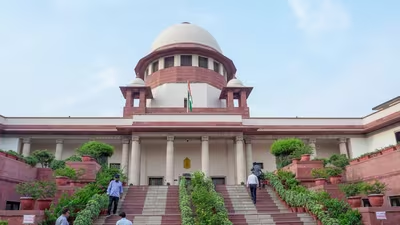
The Supreme Court on Thursday ruled that law enforcement agencies cannot circumvent the constitutional protection against prolonged custody by keeping a person in detention without formally showing an arrest, holding that the mandatory 24-hour period for producing an individual before a magistrate begins from the moment his liberty is curtailed, irrespective of when the arrest is officially recorded.
By holding that the constitutional clock starts ticking from the moment a person’s liberty is effectively curtailed, the court has taken away the discretion of investigating agencies to decide when the period of judicial oversight should begin merely by choosing when to formally record an arrest. The court also rejected the proposition that a brief period of detention before formal arrest could be treated as a temporary or permissible interruption of liberty, holding that such an interpretation would dilute the fundamental protection guaranteed by the Constitution. The court underscored that the constitutional safeguard was particularly important in the context of custodial violence, which often takes place when individuals are kept in police custody without being formally shown as arrested.
The apex court made clear that the 24-hour deadline is sacrosanct and that even a person detained for search and seizure must be produced before a magistrate within that period. The ruling settles an important question concerning the reach of Article 22(2), which mandates that a person arrested and detained in custody must be produced before the nearest magistrate within 24 hours of arrest, excluding the time necessary for the journey from the place of arrest to the court.
Rejecting attempts by some high courts to draw a distinction between detention and arrest, the court held that there could be no artificial “buffer period” during which a person’s liberty could be curtailed without triggering the safeguards under Article 22(2) of the Constitution.
The case
The judgment arose from appeals filed by four persons arrested in a case under the Narcotic Drugs and Psychotropic Substances (NDPS) Act, involving the seizure of 11.03 kg of yaba tablets in Tripura. The four were detained on September 29, 2025, at 2 pm during search and seizure operations but were formally shown as arrested only at 11 am the following day. The Tripura high court had rejected their bail pleas, holding that the stringent twin conditions under Section 37 of the NDPS Act had to be satisfied before granting bail in a case involving a commercial quantity of contraband. It had also rejected their challenge to the alleged breach of arrest procedure under Section 36 of the Bharatiya Nagarik Suraksha Sanhita (BNSS).
