
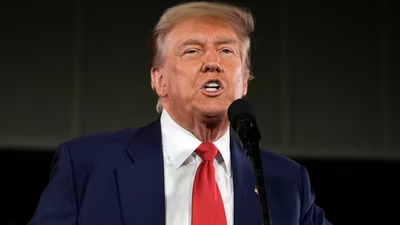
As Chinese netizens pored over the wreckage of the Republican losses in the midterm US elections, the hashtag “Trump Total Defeat” went viral on microblogging platform Weibo , garnering more than 70 million views by Wednesday evening.
Officials in Beijing , however, quickly signaled business as usual.
Mao Ning, a spokesperson for China’s Foreign Ministry, described the elections as a US “domestic affair” during a regular briefing, while showing faith in advancing “understandings reached by the two heads of state,” Donald Trump and Xi Jinping , whose third summit of the year unfolds in two weeks’ time. China will “expand cooperation, and build a China-US relationship based on mutual respect, peaceful coexistence and mutually beneficial cooperation,” Mao said.
As Trump enters the lame-duck stage of his presidency, foreign policy will remain one of the key levers under his control, sowing risk of renewed turbulence should he aim to set new agendas. Even so, prominent voices in China expect the bilateral calm to last. “But within this framework of stability, I expect more noise and more pressure from Congress. Two years after Trump swept to victory determined to ratchet up economic confrontation with Beijing, the US president is now acting as a restraint on lawmakers with far more hawkish views on China. A series of bills pending in Congress would tighten US export curbs. That would subject Trump’s bargaining with Beijing to greater scrutiny, even as his broad executive powers leave lawmakers with limited scope to dictate foreign policy.
“The overall stability is sustainable at least ’till the end of this term,” said Da Wei, director of the Center for International Security and Strategy at Tsinghua University. A Democratic-led Congress may lead to more oversight of the administration’s tariff exemptions, enforcement of export controls and deals involving sensitive semiconductor technology, said Ben Kostrzewa, an international trade lawyer at Hogan Lovells and a former US trade official. But after a bruising standoff over almost 10 years of trade wars led to a state of “mutually assured disruption” between the world’s two biggest economies, pragmatism in foreign policy will likely prevail, said Henry Huiyao Wang, founder of the Center for China and Globalization think tank in Beijing Trump’s weakened grip over Congress could inadvertently help the newly stabilized relationship between the US and China. Since the president will hold less sway with lawmakers, he’ll wield fewer bargaining chips in negotiations with Beijing, according to Feng Chucheng , founding partner of Beijing-based Hutong Research.
