
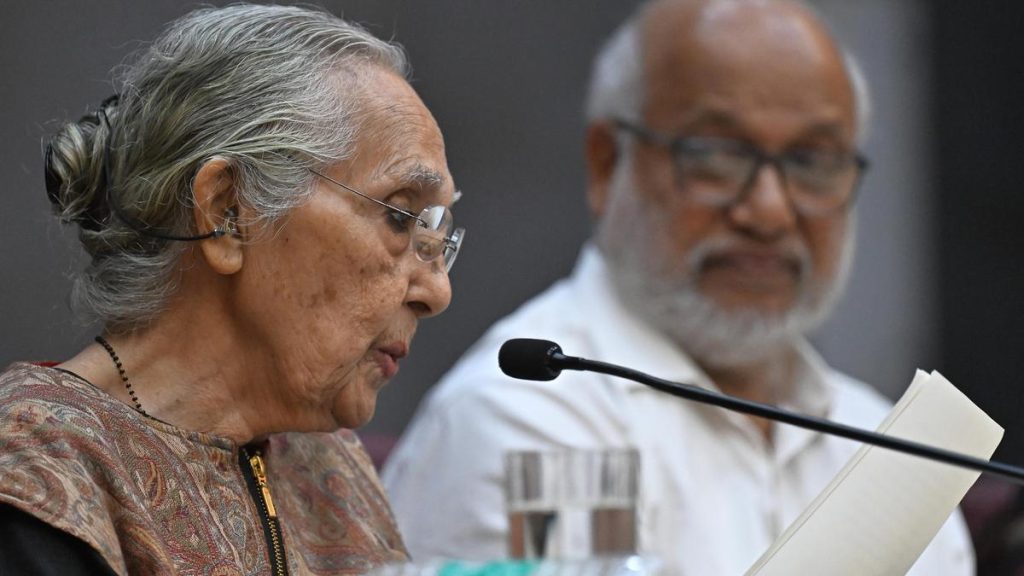
Edited excerpts from a speech delivered by Professor Romila Thapar on ‘Historiography and Early Indian History’, during the second Sitaram Yechury Memorial Lecture
I would like to thank the Sitaram Yechury Foundation for the invitation to deliver a memorial lecture. The subject I have chosen to speak on is one on which I had a small conversation with Sitaram some time back, but we did not have the opportunity to discuss it at length. I am now speaking on it in remembrance. Every society aspires to a past that explains how it came into being. Inevitably, this sometimes draws from the present and legitimizes it. The claims vary, as there is a difference between different sections of society. The questions we have to ask are: whose past are the sources referring to, who are the authors of the sources, and why and how do they want to appropriate the past? How authentic is their version of the past?
Clarifying the functions of social and economic institutions revealed fresh facets of history as in the analyses of texts. For the historian, therefore, the history of Hinduism, as also of Indian Islam, Christianity and other religions, evokes formulations and explanations from diverse backgrounds. New historical perspectives now prevail. This was to be expected in the process of decolonising. We had to be clear as to what we were decolonising. Were we just replacing Mill and Max Müller with a partisan perspective on the past where Indian commentators were often basing themselves on colonial theories anyway, or were we going to open up the analysis of the past to a range of explanations that were needed to comprehend a complex society? A more analytical understanding of the past society was required, as also an awareness of what it was being replaced with, and by whom. Theories of explanation surfaced in these readings. Those discussed more widely were not only the Marxist, but also others. For social history, the very different readings of Max Weber were also appraised. Thus, the political use of the past has become apparent in the adaptation of history to the ideology and requirements of Hindutva. Historiography led to better-directed questions on the social infrastructures. Many questions began to surface. For example, did the polity change? Were there only kingdoms for four millennia or did some chiefships – gana-sanghas – change into kingdoms – rajyas – with a few kingdoms becoming the hub of empires in different periods? That all empires are highly centralized and uniform may be a convenient theory to underline political control, but does it explain the actual functioning of empires? The most substantial change was when, in modern times, kingdoms and colonies mutated into democratic nations. (or hoped to do so). The new national identity brought diverse groups into a single nation, which was also a historical process of change. Nationalism splintered into a Hindu and a Muslim nationalism, and now secular nationalism is fighting for survival. History was read differently by secular nationalists from those insisting on a Hindu or a Muslim nationalism. Recognizing patterns of political control in history – whether of chiefships, kingdoms, or empires – required investigating the social basis of their economy, among other aspects. This is common sense. It doesn’t need a theory to say so. If land relations were based on a different pattern in post-Gupta times from that of pre-Gupta times, as the evidence from inscriptions suggests, then how did the change happen? What permitted Mauryan administration to control large parts of the sub-continent and even beyond? What was the impact of the very lucrative long-distance trade, both overland and maritime? There were impressively large places of worship, mosques and temples in the second millennium CE. The temples were for Shaiva, Vaishnava and Shakta worship, and some Jaina as well, on all of which much wealth was spent. Where did kings and devotees get the wealth to finance these? This would be added information of considerable interest. References to varna and jatis/castes go back to early times. Curiously there is no mention of them in Ashoka’s edicts centrally concerned with society. But other sources register changes through the centuries. The cause of this may be variations in regional economies and social norms, diverse kinship systems, and changing ownership of resources. Religious sects also had a presence. Society was not static, so change would be expected. The change has to be explained. For example, why did the two Semitic religions, Christianity and Islam, although professing the equality of all, nevertheless permit the continuance of discrimination by their converted elite groups against the lesser castes? Colonial scholars explained Hinduism as a somewhat exotic religion. It was assumed that all religions were monotheistic. But the religions of India were, in belief and practice, largely pluralistic, with many sects emanating from diverse teachings. Some were flexible and some rigid, some were more agglutinative and some pared down, some shone in their extensive plurality whereas others stayed close to a narrower singular belief. Religious sects were prolific and juxtaposed and proximity meant that some exchanges between them were inevitable, as also the evolution of new sects. This suggests the need for new ways of studying the religion and comprehending the diverse patterns. The pluralism of the religion is even more evident in the absence of restriction in the range and form of devotion, as is evident from the multiple Bhakti sects. The rituals of worship could be particular to a sect. The projection of the same deity could be exclusive to a region, for example, Vishnu as Jagannath in Odisha and as Vitthala in Maharashtra. Each had different identities. The idiom of worship was devotion, but the form could differ. It was later, in colonial times, that new kinds of institutions evolved, the samajs, that seemed closer to an organized religion. The Shramana religions held views that differed from the Hinduism of the Puranas, as did the materialist philosophy of the Charvaka. The same goes for some of the Bhakti teachers. Dissent was expressed, even if occasionally it led to serious conflict. Debating opposing views on a subject was recognized as a philosophical procedure, the outcome of which could bring a possible solution — a procedure somewhat similar to the dialectic in philosophical ideas. When, on the contrary, it is maintained that there is only one strand to Hinduism and that it is a simple monotheistic religion, one does rather wonder which religion is being discussed. This kind of formulation does not reflect the historian’s research into the history of the religion, where history is different from belief. It is more appropriate to the manner in which a religion can be put to political use, arguing for the priority claimed for the majority community, aspiring to establish a nation, in this case a Hindu Rashtra. These questions in relation to a religion have to be asked if its history is sought. They are not anti-religious but are simply reiterating that religion is always embedded in a society, and knowing the ambience of the society is necessary to even fully comprehend the religion. Let me say in conclusion that the facets I have spoken of are but a part of what historians are investigating. These questions, so essential to studying the past, have their genesis in historiography. We need to give historiography the intellectual status that it is entitled to. This will not happen through a Hindutva reading of Indian history which is single and fixed, with no scope for further discussion. In this interpretation, the purpose of history is not to explain what happened in the past, but instead to construct statements for contemporary political use. These statements deny the centrality of secularism and democracy, as essential components of the new nation, emerging from a colonial experience. However, the denial is already being challenged, despite the malicious attacks at various levels, by those who challenge the denial. Professional historians and some among those associated with them are researching the historical evolution of Indian society and economy, quite distinct from that imagined and propagated by Hindutva. We look forward to the new dimensions that historiography will reveal about our history.
Slowly, the importance of historiography is being recognised in questions such as who is investigating the past today, how is the past being propagated, and with what intention?
