
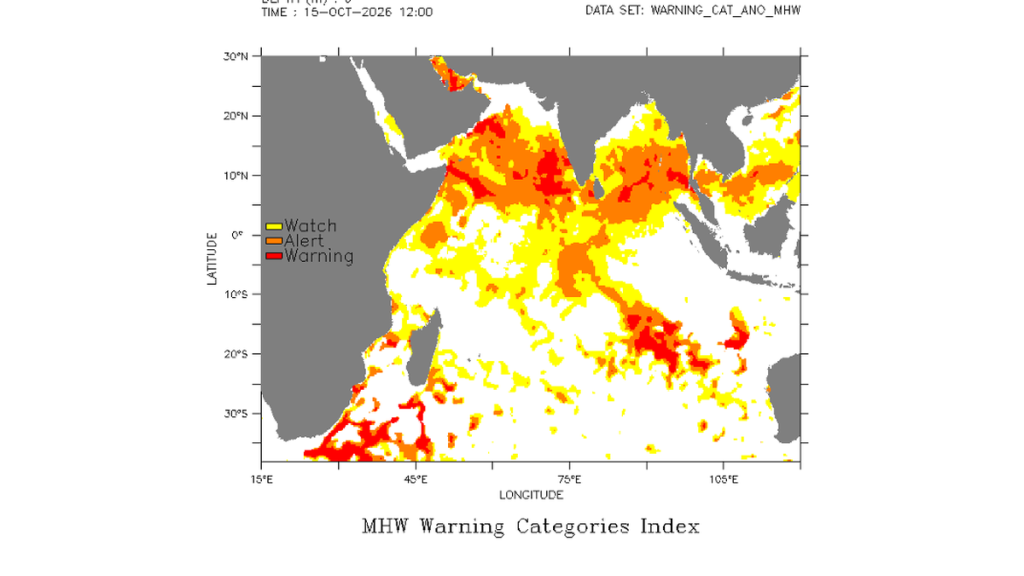
The Indian National Centre for Ocean Information Services (INCOIS), a research organisation under the Ministry of Earth Sciences (MoES), has issued a Marine Heat Wave (MHW) warning across the Arabian Sea, the Indian Ocean and the Bay of Bengal. The warming conditions could adversely affect coral reef ecosystems, marine productivity and coastal biodiversity.
Scientists are also assessing the intensity of marine heat waves and their potential impact on seagrass meadows, seaweed ecosystems and fisheries. These conditions could lead to biodiversity loss , shifts in species distribution and long-term ecological changes linked to climate change. The intensity of the marine heat waves has largely been classified under the ‘Watch’ and ‘Alert’ categories, indicating sea surface temperature anomalies of up to 1 degree celsius above normal levels. The study area covered under this service is divided into six ocean basins, including the Persian Gulf, Red Sea, Southern Indian Ocean and South China Sea, as well as 14 sectors along the Indian coastline for detailed regional analysis.
INCOIS on Wednesday (November 4, 2026) has also issued a swell surge warning for both the east and west coasts for the next two days, including the Andaman and Nicobar Islands. A danger alert was issued for Car Nicobar Island.
Waves of one metre or higher are expected to impact the coasts of Gujarat, Goa, Maharashtra, Karnataka, Kerala, Odisha, Andhra Pradesh, Lakshadweep, Puducherry, Tamil Nadu and West Bengal, according to an official bulletin.
