
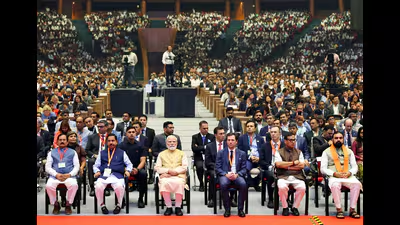
Prime Minister Narendra Modi on Monday said India’s decade-long shift to renewable energy had helped the country sustain high economic growth despite global disruptions, including the Covid-19 pandemic and the West Asia crisis.
“The West Asia crisis is still ongoing. Inaugurating the Bharat Renewable Energy (BRE) Summit & Expo 2026 at Bharat Mandapam in New Delhi , Modi warned that continued over-reliance on fossil fuels would repeatedly disrupt the global economy. He said the future of energy security lay in clean energy and announced that India planned to install another 500 GW of non-fossil energy capacity over the next 10 to 11 years. But 140 crore (1,400 million) Indians take pride in how effectively the nation has managed the turmoil while maintaining high economic growth,” Modi said in his inaugural address. Reviewing the PM Surya Ghar Muft Bijli Yojana, launched in February 2024 to install rooftop solar panels in one crore homes, Modi said over 6.5 million households had joined the programme within 24 to 25 months, at a pace of 100,000 new homes every six days. He said the scheme had cut electricity bills by roughly 76%.
He said a decade of sustained domestic investment and systemic reforms in clean energy had shielded India from severe external shocks. “If India had not invested in clean energy and created new systems for this over the past decade, then our crisis could have been much more severe than the rest of the world,” he said. Noting that the summit coincided with the ninth assembly of the International Solar Alliance and included delegates from the Fourth Conference on Green Hydrogen, Modi said fossil reserves were finite and concentrated in a few regions, unlike the boundless and universally accessible potential of clean energy. “We all know, the future of energy security lies in clean energy,” he said, describing India’s 12-year clean energy journey as one defined by promises, passion and performance, exemplified by its COP-26 commitment to achieve 500 GW of non-fossil capacity by 2030. Modi said India remained committed to ensuring that funding, technology and expertise reached every country in need. “For Africa, a proposal for a $200 million Africa Solar Facility has also been put forward,” he said, adding that the coming decade was vital for global climate goals.
Over the past 12 years, Modi said, more than 44,000 government buildings had been connected to solar energy, saving nearly ₹ 700 crore annually, while the KUSUM scheme had provided solar irrigation to over 3 million farmers.
