
Superstardom in Indian cinema is a curious thing. Retroactively, Dilip Kumar and Ashok Kumar have been called that, but Rajesh Khanna was the first Bollywood star for whom the term was used. And within five years of him being called that, the actor was struggling to land hits. In a decade, he was almost obsolete. Many Indian superstars have faltered in their 50s, unable to adapt to changing times and losing their grip on the masses.
Since then, sustaining superstardom has been key.
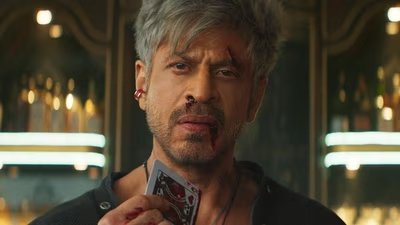
SRK’s silver fox turn in King may just be the start of his ‘Rajni era’ or a false dawn. But it shows the actor is willing to change. Yet the film’s promotional campaign begins with a very Besharam Rang-esque romantic song featuring Deepika Padukone. Maybe the Jailer turn is for a future film. But at least Shah Rukh has a blueprint to follow.
Strangely enough, Shah Rukh Khan has had no such trouble. Despite facing a turbulent time at the box office, followed by a period of uncharacteristic reclusion, he remains the audience’s favourite. It is what he does next that will determine how this superstardom continues, and he has just the blueprint he needs. He idolises Amitabh Bachchan, but if Shah Rukh has followed a blueprint for stardom, it’s one of Dilip Kumar. The Tragedy King began as a romantic hero in the 1940s, before establishing himself as a dramatic actor. Shah Rukh would do the same four decades later. He even did the same kind of films, playing lovable, tragic heroes. In his 50s, Dilip Kumar faced his first failure as films such as Bairaag and Sagina flopped. Dilip Kumar took a five-year hiatus and returned with a bang in Kranti, an action potboiler. Shah Rukh did the same with Pathaan and Jawan. In his 60s, Dilip Kumar, the once-lovable romantic star, turned action hero, starring in mega films that featured large ensemble casts. Both Vidhaata and Karma were blockbusters, while Mashaal and Saudagar were also big hits. This is what Shah Rukh would aspire to do. But there is a chance of failure too. Rajinikanth is an example. After lording it over Tamil cinema in the 1990s and 2000s, Rajinikanth faced setbacks in his 60s. The back-to-back failures of Kochadaiiyaan and Lingaa led people to say that the superstar was ‘finished’. Rajinikanth transformed the kind of roles he took on. He was now the vengeful grandfather, the retired jailer, the veteran cop. There was no romance with women in their 30s (or even 40s). He was still the hero, but close to his age. Two other superstars, Amitabh Bachchan and Ashok Kumar, went the ‘character actor’ route in their 60s. Ashok Kumar made the switch in his 50s with supporting roles in Jewel Thief and later added to that with films such as Aashirwaad. For Amitabh Bachchan, the turn began with Major Saab and solidified with Mohabbatein and Kabhi Khushi Kabhie Gham. But Shah Rukh seems to be in no mood to play second fiddle to younger heroes. Even if he has to play a man with grey hair (as in King), he clearly wants to be the hero, not the ‘token old superstar’.
As he turns 61 today (November 2), the actor sits at a crucial juncture in his career. For a while, in the mid-80s, Dilip Kumar, 65, was a bigger box-office draw than Bachchan at his peak. He roared back with Kabali and 2.0, before re-establishing himself as Tamil cinema’s top star in his 70s with hits such as Jailer, Coolie, and Jailer 2.
