
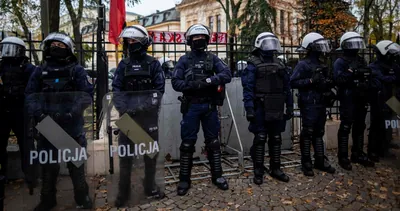
One of the judges, Anna Korwin-Piotrowska, said that she was suspending the court’s president, Bogdan Swieczkowski, and his deputy for 30 days on grounds of obstructing the court’s functioning. POLAND’S Constitutional Tribunal is supposed to embody democratic stability, but has spent the past decade as a battleground for fights between populists and liberals. The latest conflict looks like a full-blown constitutional crisis. On the evening of October 30th a group of judges picked by parliament this year, but whom the country’s president has refused to swear in, strode into the court building while riot police secured the grounds.
She said she would assume the presidency herself.
The scene quickly devolved into the sort of undignified standoff that has typified Polish politics for years. Several hundred protesters gathered outside the court, including someone wearing the armour and wooden wings of a medieval Polish hussar. Mr Swieczkowski and opposition leaders accused Donald Tusk, the prime minister, of staging a coup. Karol Nawrocki, the country’s president and, like Mr Swieczkowski, an ally of the populist-right Law and Justice (PiS) party, had been en route to Senegal. He turned his plane around and returned to Warsaw, where he and his entourage forced their way into the building, pushing Ms Korwin-Piotrowska out of the way. The situation remains at an impasse. A showdown awaits on November 3rd, when Ms Korwin-Piotrowska will convene the court’s judges to adopt its budget. Mr Tusk and his Civic Platform party see the move to seat the judges as part of an effort to restore the rule of law , which was severely degraded under PiS’s eight-year-rule. They refused to seat five judges appointed to the Constitutional Tribunal by the previous government and instead named judges of their own. Mounting conflicts over the judiciary led the European Union to withhold billions of euros’ worth of funds from Poland. After years of disputes the EU’s highest court, the European Court of Justice, eventually ruled PiS’s substitution of judges illegal and stopped recognising the tribunal’s decisions. The president has no constitutional role in appointing judges to the tribunal. Mr Swieczkowski has barred them from hearing cases, and the tribunal has been paralysed. It seems to have been a mistake by Mr Tusk. The liberal coalition that brought him to power grew out of a long campaign to restore constitutional rule. Veterans of that fight have little love for the PiS-aligned tribunal. But many find the effort to use police power to depose its leadership unacceptable.
On taking office in 2015 the populists tried to take political control over the country’s judiciary. When he returned to power in 2023 Mr Tusk and his government first tried to reform the tribunal, but were blocked by Mr Nawrocki’s predecessor, also a PiS ally.
Mr Nawrocki has refused to attend the judges’ swearing-in ceremony, and says this means they are not legitimate. Mr Swieczkowski is “the worst possible person to serve as president of the constitutional court, but there are no legal grounds for [suspending] him,” Marcin Matczak, a constitutional scholar, wrote on X the evening of the confrontation. “You cannot restore the rule of law by force.”
Since then they have been nominating new judges as vacancies on the court arise. But Mr Nawrocki has kept five of them out using a loophole: Polish law requires new tribunal judges to take their oath of office before the president.
The Venice Commission, a European legal authority, has ruled that the president’s role in swearing in judges is ceremonial and that Mr Nawrocki is misusing it. Poland’s president offers confusing rationales for his blockade, but it is widely understood to be political. Mr Berek is a respected lawyer, and there is no rule against appointing former government officials: PiS named several to the tribunal while it was in power, including Mr Swieczkowski, who had served as deputy justice minister. It was hardly in keeping with his campaign promises to depoliticise the court. And forcibly installing the judges his government has picked looks like a political stunt. Parliamentary elections are due next year, and Mr Tusk seems to be trying to show his supporters, who have been disappointed by his failure to root PiS’s appointees out of the system, that he is doing something. The crisis is a boon for PiS. The standoff over the court gives PiS a chance to lead the charge against Mr Tusk and recover its standing as the country’s main opposition.
Since 2023 the populists have been shedding voters to two far-right rival parties, Konfederacja and Korona. In August 40 MPs headed by Mateusz Morawiecki, a former prime minister, abandoned PiS to form a more moderate party, Development Plus. Because he served as a minister in Mr Tusk’s government until earlier this year, he objects to Maciej Berek, named to the court in September,.
But picking Mr Berek, whom Mr Tusk once described as his “right-hand man”, was a provocative move.
