
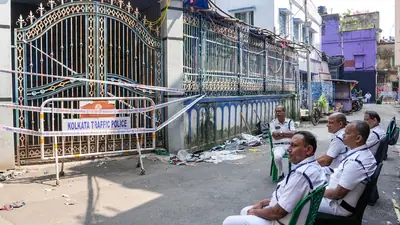
A walk through north Kolkata is a lesson in anachronism. Its narrow, mazy lanes are flanked by cramped residential blocks and sprawling ancestral mansions in equal measure. Its neighbourhoods struggle to breathe and offer vast open spaces in the same breath.
Then a loudspeaker announced that the pandal structure might collapse, according to police and eyewitness accounts. The neighbourhood’s pujas now draw hundreds of thousands of people every year, packing them into streets planned and built for far more modest numbers. Thousands filed through a narrow lane towards the Chorbagan Sarbojanin puja, one of the neighbourhood’s oldest pandals. Then the skies opened. People outside pushed forward for shelter while those inside hesitated to step into the downpour. As the opposing flows jammed together, pressure built around the narrow exit. In the panic, people rushed to escape. The crush knocked some off their feet and trapped them. Nineteen people died. Kolkata’s was not the first gathering to end this way. Eleven died outside Bengaluru’s M Chinnaswamy Stadium, where fans had gathered to celebrate a cricket victory. India’s fast-densifying cities are compressing more people into the same old streets, squares and festival routes. Social media can turn religious festivals, political rallies, consumer expos and concerts into sudden mass gatherings, while the physical layout of the city barely changes. People now gather, celebrate and move in tighter, and often more dangerous, spaces. Singh describes what that means on the ground: “The gali [lane] was never planned for fifty thousand visitors. The disaster plan covers flood and fire. And on the night, a few constables at a gate, soaked to the skin, are asked to hold back physics. “Instead of pushing governments to take decisive action, we have normalised these tragedies as inevitable in a populous country, quickly forgetting one and waiting for the next. In his view, it places blame on the people caught in a crush and takes attention away from organisers and authorities. “Human crowds are a complex system, yet crowd dynamics in India has not focused on treating and developing it as a scientific discipline. The problem is not simply that the police arrive late. No one may have properly assessed the space in the first place. “What matters most is actual walking width, the part people can actually walk through once parked vehicles, pandal structures, hawkers and food stalls are accounted for. In older temple areas, shrines and statues can narrow it further. She also wants the community involved. “When only the police are made accountable, the community cuts itself out from management and simply becomes a part of the crowd. Safety depends on the whole pedestrian network, including approach roads, junctions, exits and alternative routes. Bengaluru is a case in point. The commission headed by justice Michael D’Cunha found that the event had no prior permission, the gates opened directly onto public footpaths and there were no holding areas. The commission blamed organisers and police for poor entry regulation, reckless announcements and the delayed opening of exit gates. “But while technology provides real-time information, an alert is useless if nobody acts on it. The decision ultimately has to be made by a human. Technology can help before an event too. “We can change how people move through it. Supported by proper infrastructure and well-designed public spaces, it can strengthen urban vitality.
On the evening of October 17, Saptami, families dressed traditionally for Durga Puja filled those lanes. By 7.40pm, the approach was packed. A crush at the Maha Kumbh in Prayagraj last year killed 37 people. At a rally featuring actor — now chief minister — Vijay in Karur, Tamil Nadu, 41 people died. The National Crime Records Bureau recorded 147 deaths in what it classifies as stampedes across India in 2024, according to its year-wise dataset. The Chinnaswamy Stadium can hold about 35,000 people, but then chief minister Siddaramaiah said between 200,000 and 300,000 had gathered for Royal Challengers Bengaluru’s victory celebrations. Of the 515 personnel assigned for the event, only 79 were posted outside the gates. “If the exits clear 20,000 an hour, you do not let in 60,000.
“A review of every incident and near miss must be published, so that Prayagraj learns from Kolkata.
OP Singh, former director general of police in Haryana and author of When the Crowd Holds the Camera, to be published by Penguin Random House India in December, calls a crowd “our most predictable disaster”. “We know the date, the place and the number a year ahead,” he says. The police response, he says, often arrives as a bandobast: “a list of men, points and shifts drawn up a week before”. Ashish Verma, a professor at the Indian Institute of Science (IISc), Bengaluru, says crowd disasters have occurred frequently for decades, “almost once in a month on an average”. The root problem is that authorities treat crowd management purely as an administrative task to be handled by police and security personnel using kinetic force,” says Verma, whose research examines crowd dynamics, pedestrian movement and walk-accessibility during mass gatherings. Verma also questions the use of the word “stampede”. The country has put little into training specialists or building academic programmes for them,” he says. Also Read I Women congested exit gate to protect themselves from rain leading to stampede, says Kolkata police Monika Vij, a professor of geography at Miranda House, Delhi, has used remote sensing and geographic information systems (GIS) to map pressure points at pilgrimage sites. Planners, she says, often get the first calculation wrong: the width of the lane. Sometimes the lanes are so narrow that the entry and exit points are the same, leading to counterflow of people,” she says. Police plans divide a site into posts and sectors, Vij says, while spatial analysis looks at its physical features and how people move through it. “Carrying capacity and pressure points have to be worked out in advance,” she says. Dikshu Kukreja, architect and managing principal at CP Kukreja Architects, says the problem is also one of planning. Master plans and street designs look at land use, connectivity and infrastructure, he says, but rarely give the same attention to the periodic crowding of particular places. Public space changes with the hour, the season and the event, Kukreja says, and planning needs to account for this temporal dimension. “A venue can become unsafe if even one critical section of its access network is unable to accommodate the volume of people moving through it,” he says. Verma says people need to be channelled into orderly, preferably single-file movement, or a rumour, a sudden stop or heavy rain can send pressure through a crowd. “A barricade cannot calm a crowd that got there first,” Singh says. Atul Rai, chief executive and co-founder of Gurugram-based artificial intelligence firm Staqu Technologies, which was brought in to deploy crowd analytics at the stadium after the crush, says its software tracks crowd density, bottlenecks and unusual directional movement in real time, and automatically alerts control rooms before overcrowding reaches a critical level. “Effective crowd management relies on assessing real-time inflow and outflow speeds rather than relying solely on static headcounts,” Rai says. Vij says satellite imagery and GIS can identify narrow lanes, obstructions and places that could serve as holding areas. “Nobody can widen a 200-year-old lane,” Singh says. That, he says, starts with knowing the usable space: where routes narrow, which exits lead to open ground and where people can wait without blocking the street. Organisers should work out the expected crowd, the number of exits and the time the site takes to empty, Singh says. On the eve of a festival, he says, the puja committee, engineer, fire officer and police station head should walk the lane together. “A plan nobody has walked is only paper,” he says. Kukreja says density by itself is not the problem. Cities, he says, need to plan for collective gatherings with the seriousness given to transport or utilities. “A festival crowd is families who came out to celebrate,” Singh says. “We owe them a place that was ready before they arrived, and a safe way home.”
Historically home to prominent families such as the Tagores, Mullicks, Chatterjees and Seals, north Kolkata is where Durga Puja took on its modern, community-driven shape centuries ago. “What protects people on the night is built months earlier.
Among them was a seven-year-old girl who had come with her family, like so many others that evening, simply to see the pandals.
Singh recalls watching a marathon in Hisar from a footbridge. “That is crowd design. The safety is settled before anyone arrives. Also Read I Kolkata Durga Puja stampede: SIT zeroes in on narrow exit point, dimly lit pathway
Because they knew the start, the route and the finish, the runners moved calmly.
