
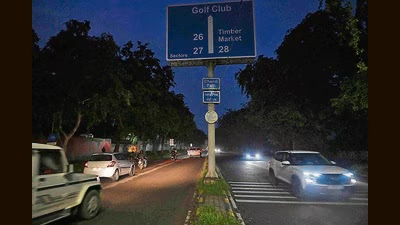
As Chandigarh prepares for Diwali, homes will be dressed in fairy lights, markets will glow with festive decorations and buildings will compete for attention. For a few evenings, the city will appear brighter than usual. Yet beyond these illuminated pockets lies a less celebratory reality. Several of Chandigarh’s pedestrian paths, cycle tracks and public spaces remain inadequately lit. The contrast raises an uncomfortable question: why does a city capable of lighting up for a festival struggle to illuminate spaces its residents use every day?
The dark side of the grid Chandigarh’s planned road hierarchy and extensive cycling infrastructure are among its defining urban features. But infrastructure that works in daylight must remain usable after sunset. The audit also recorded faded markings, vegetation encroachment and poor surface conditions. These deficiencies become particularly dangerous when they occur together. A cyclist approaching an uneven surface, an obscured bollard or an unexpected obstruction has less time to react in poor visibility. A dedicated cycle track offers limited protection if its condition discourages people from using it. The problem extends beyond cycling. A city that accommodates thousands of students must also consider how safely they travel between institutions, bus stops and residential neighbourhoods. Beyond the streetlight
A recent safety audit by Punjab Engineering College examined four corridors spanning 44.05 km of the city’s cycle-track network. It identified non-functional streetlights at 37 locations along Shanti Path, 19 along Chandi Path and 18 along Sarovar Path. Recent reporting from Sector 34, one of Chandigarh’s busiest coaching hubs, described students using mobile phone torches to navigate poorly lit parking areas and pedestrian routes after evening classes.
Beyond decorative illumination In September this year, Chandigarh’s Municipal Corporation invited bids for a 10-year programme to modernise approximately 45,871 LED light points, introduce centralised monitoring and strengthen the aging electrical infrastructure. Technology alone, therefore, cannot substitute for sustained maintenance. Good streetlighting involves considerably more than installing poles at regular intervals. In lighting design, illumination levels, uniformity and glare control are fundamental considerations. Uniformity is particularly important. A brightly illuminated stretch followed by sudden darkness can make obstacles harder to identify as the eyes adjust to changing light levels. There is also a distinction between lighting roads for vehicular traffic and illuminating pedestrian pathways.Tall streetlights may adequately illuminate carriageways while leaving adjoining footpaths in shadow. Trees, although indispensable to Chandigarh’s landscape, can obstruct poorly positioned fixtures. Pedestrian-scale lighting, appropriately positioned near crossings, bus stops and frequently used pathways, improves visibility where it matters. Downward-directed fixtures can also reduce glare and unnecessary light pollution. This is where Chandigarh’s planning demands a more considered approach. Its green belts, tree-lined avenues and segregated movement networks require lighting designed around actual patterns of use rather than a uniform arrangement of fixtures. The objective should be appropriate visibility, visual comfort and continuity. The proposal is revealing. Many existing monitoring panels have reportedly become non-functional, while ageing fixtures have reduced illumination levels. The city needs regular night-time audits, accessible fault reporting, prompt repairs and coordinated pruning of vegetation obstructing streetlights. Priority must be given to pedestrian crossings, cycle tracks, bus stops and routes connecting public facilities. Importantly, lighting must be evaluated from the perspective of someone walking or cycling, not merely someone driving through. Diwali celebrates the triumph of light over darkness. For Chandigarh, perhaps the more meaningful celebration would be ensuring that illumination extends beyond decorated façades and festive markets. After all, the true measure of a well-lit city is not how brightly it shines on special occasions, but how safely its people can move through it on ordinary evenings. [email protected] (The writer is a Chandigarh-based architect and interior designer)
