
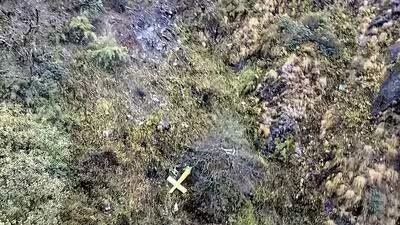
Six people were killed after a helicopter crashed near Joshimath in Chamoli district on Friday, adding to a series of accidents in Uttarakhand’s pilgrimage helicopter sector despite successive rounds of safety measures by the aviation regulator.
These included air traffic control at Sahastradhara in Dehradun and Sersi in Rudraprayag, command centres monitoring helipads and weather, tracking devices on all helicopters, and ceilometers — instruments that measure cloud-base height — at five locations including Kedarnath and Badrinath. The Char Dham sector’s safety record has drawn repeated regulatory intervention. It also recommended that the Directorate General of Civil Aviation (DGCA) exercise oversight of the Sitapur control centre and that radio communications between pilots and ground controllers be recorded. The AAIB attributed the accident to the crew’s failure to adequately assess deteriorating weather conditions, with fast-descending clouds obscuring visibility. DGCA has responded to accidents with audits, inspections, fines and suspensions.
The crash occurred weeks after the Aircraft Accident Investigation Bureau (AAIB), in its final report on a fatal 2025 crash in the Kedarnath valley, recommended that pilots complete 50 hours of supervised hill flying before operating alone in the region. The bureau recorded eight accidents and one serious incident in the Char Dham sector between 2015 and 2025. The accident is the first in Uttarakhand since the civil aviation ministry introduced sweeping safety measures for the 2026 pilgrimage season. Pilots were required to have at least 750 hours of hill flying, with 100 in the preceding year and 10 take-offs and landings at Kedarnath. Helicopters were barred from filling more than 70% of their passenger capacity. The ministry had said the first phase of the 2026 season passed without incident. Data the ministry presented in the Rajya Sabha on July 21 last year showed six helicopter accidents during the Char Dham Yatra between 2021 and June 2025, four of them in the first six months of 2025 alone. One accident each was recorded in 2022 and 2023; none in 2021 and 2024. The deadliest recent cluster came in the 2025 season. On May 8, an Aero Trans Services Bell 407 crashed near Gangnani in Uttarkashi after its main rotor struck an overhead fibre-optic cable during a landing attempt, killing six people and seriously injuring another. On May 17, a Pinnacle Air helicopter was involved in an accident near Kedarnath, followed by a Kestrel Aviation helicopter accident at Sersi on June 7. On June 15, an Aryan Aviation Bell 407 flying from Kedarnath to Guptkashi crashed near Gaurikund, killing all seven people on board. The AAIB’s final report on the Gaurikund crash, issued on October 13 this year, identified the pilot’s limited experience of flying in the valley, rapidly descending clouds and the failure to turn back or change course in time among the factors relevant to the accident. It recommended that pilots complete at least 50 hours of supervised dual hill-flying sorties with an experienced pilot before undertaking single-pilot operations in the Kedarnath valley for the first time. The 2022 Kedarnath crash showed a similar pattern. On October 18 that year, an Aryan Aviation Bell 407 crashed into a mountain ridge near Garud Chatti shortly after taking off from Kedarnath, killing all seven people on board. After a hard landing at Kedarnath in June 2022, it audited shuttle operators and fined five of them ₹ 5 lakh each over irregularities in their flying records. After the April 2023 tail-rotor death, it ordered a second audit of all operators before clearing them for the season and announced specialised training for Himalayan flying.
